Tampa
The thriving west coast city of Tampa
is out to prove that not all the action in the warmly-welcoming southern state
of Florida happens at Miami
Beach or Cape Canaveral. At the
heart of its revitalization is Ybor
City, the historic heart of the old
cigar industry.
Tampa is also living testimony
to the fact that not every Floridian has an incurable predilection for Gloria Estefan and a sartorial insensibility that teams B-Grade
actors, five-o'clock-shadows, and pastel jackets with rolled-up sleeves. Miami
Vice, you have a lot to answer for.
While it's true that Tampa, in combination with nearby St Petersburg, is
energetically promoting the sundry pleasures of holidaying off the annoyingly
pleasant Gulf of Mexico, it's also attempting to throw off the big-haired,
buffed-bod, rollerblading stereotype that sticks like
fake tan to any city south of the 30° parallel.
Population: 285,000
Country: USA
Time Zone: GMT/UTC -5
Telephone Area Code: 813
Orientation
Thrusting out rudely towards Cuba
from the southeastern corner of the USA,
where it helps keep the placid Gulf of Mexico to the
west from mixing socially with the rather more temperamental Atlantic
Ocean to the east, is the fat little
peninsula that the majority of the state of Florida
calls home. Florida also claims a
comparatively small strip of North American turf jutting out from below the
southern borders of Alabama and Georgia.
It's known colloquially as the Panhandle due to its undeniabley
panhandley shape.
Strung out along the peninsula's east coast are prominent Florida
sites like the space-shuttling Cape Canaveral, the
theme-park scramble of Walt Disney World and the garish pastels of Miami's
Art-Deco architecture. Refreshingly, the western side of the peninsula is a far
less trammeled and fashion-conscious stretch of coastline. About halfway along
the west coast are the sheltered confines of Tampa Bay, on the northern shore
of which is its urban namesake, closely shadowed to the west by the
similarly-sized city of St Petersburg.
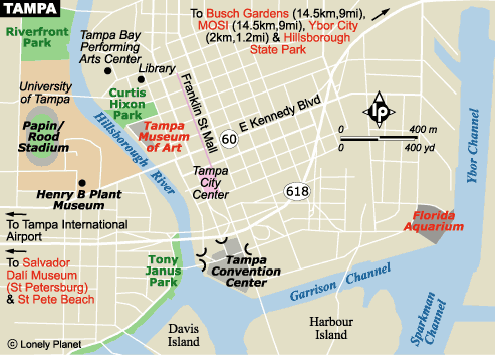
Tampa's highway-threaded
downtown area is mainly on the eastern bank of the sizeable Hillsborough
River, which empties out beyond
compact Davis and Harbour Islands
into the small Hillsborough Bay.
Making up the rest of the main local watercourses are Garrison Channel, which
is the southern boundary of the downtown area, and Ybor
Channel, which skirts the inner city 0.6mi (1km ) to
the east. Franklin St,
which runs north-south, is a pedestrian mall for most of its length. Two blocks
east and running parallel to Franklin
is Marion St which closes
itself off 6am-7pm to all motorized
traffic except public buses. Lying in Tampa's
northeast is the distinctive Ybor
City district, once the hub of the
country's cigar industry and now the hub of Tampa's
nightlife.
Tampa International Airport is located 13mi (21km) west of downtown, while
the city's Greyhound bus terminal is on Polk St - just east of Franklin St -
and the local Amtrak train station is further east on Nebraska Ave.
When to Go
The best weather and the greatest crowds occur from December until May, when
temperatures average between 60°F and 80°F (15°C and 27°C), rainfall is slight
and communal spirits are high. From June to September, soaring heat and pouring
rain combine to create one huge open air humidor, a dramatically clammy and
unpleasant atmosphere in which ferocious thunderstorms are frequent
early-afternoon visitors.
This is also part of Florida's
hurricane season which officially runs from June through November. The season
regularly passes without catastrophic incident but as recently as a decade
ago, a category-4 hurricane (innocuously and rather deceptively called Andrew),
generating winds of up to 155mph (250kmph) and ocean surges over 18ft(5.5m)-high,
passed through Florida on its way to becoming the most expensive natural disaster
in US history. Oh, and did we mention that Florida
has about 70 types of blood-sucking mosquitos? The
only real reason for considering an extended visit at the peak of summer is
that many other tourists will seriously consider staying away.
HOME
Attractions
Busch Gardens
Competing with Walt Disney World to empty the wallets of Floridian fun park
aficionados is Busch Gardens, an African-themed exercise in big-budget
amusement that's located on its own boulevard about 3mi (5km) north of downtown
Tampa. Busch is equipped with a number of rides designed to scare the crap out
of you and everyone in your immediate vicinity, including an inverted roller
coaster called Montu that has a 104ft (31m)- vertical loop and another coaster (Kumba)
with a 360° spiral and an endless supply of loop-n-puke twists. The park also
has a mock Egyptian area that would make King Tut
weep with nostalgia, a landscaped domain stocked with gorillas and chimps, and
an 80ac (32ha) imitation of the Serengeti that's inhabited by lions, zebras,
giraffes, camels and other large mammals. Next door to Busch
Gardens is Adventure
Island, a 36ac/14ha water park with
various slide rides, swimming pools and waterfalls.
Florida Aquarium
The wonderful three-storey Florida Aquarium is on Channelside Drive, so-named
because it runs alongside Ybor Channel to the east of
downtown. The aquarium's thematic exhibits range from a wetlands recreation -
complete with limestone cave, mist-topped water, mangroves and resident turtles
(plus some alligator spawn) - to an indoor dune-studded beach and a coral reef
that's held prisoner in a very large tank. With its coral-littered interior,
fish-starred waters, and staff divers that take turns cataloguing the
incredible display of sea life to a watching crowd via an intercom system, the colourful reef is a highlight of any visit to the aquarium.
If, after visiting the aquarium, you still haven't had your fill of
creatures great and small, head northeast out of downtown towards Busch Gardens
and you'll soon run into the enclosure-dotted environs of Lowry Park Zoo. This
is where the alligators and bison roam...captive, and
assorted birds flap around a huge aviary. Rare animals that have been given
shelter here include the Florida panther (less than 50 still in the wild), the
ocean-dwelling Florida manatee or sea cow, and an Indian rhinoceros (both these
last two numbering less than 2000 in the wild). Even stranger looking animals
given shelter here include the naked mole rat, a subterranean critter from
northern Africa. Next door to the zoo is the Children's Museum
of Tampa, with heaps of interactive
displays and a shrunken replica of downtown where kiddies can play superboy (or girl) and leap tall buildings in a youthful
bound.
Museum of Science & Industry (MOSI)
Mosey along to MOSI to see one of the most educational, absorbing and
child-friendly science fairs in Florida.
Set up in an impressively overfed building on Fowler
Ave, to the north of Tampa's
downtown, the museum is wedged between the academic campus of the University
of South Florida and the no-brainer
rides of Busch Gardens,
and contains a terrific array of hands-on exhibits. You can play an oversized
game of pinball to see how energy is produced, take out the average American's
distinctly greater-than-average amount of domestic trash, and pilot a small hot
air balloon (though unlike other ballooning trips, this one comes without a
sunrise or a glass of champagne). The museum also has various changing exhibits
and an IMAX cinema where you can get up close and personal with the images on
the screen.
Museum fanciers should also make the short trip west from downtown across
the Hillsborough River
to the University of Tampa
campus. At the southern end is the whimsical Henry
B Plant Museum.
It may sound like a botanical garden but it's actually a restored
welcome-if-you're-filthy-rich hotel that was built in 1891 by Florida
railroad magnate Henry B Plant. In its day it was about as luxurious an
accommodation option as you could get, with extravagantly outfitted en-suite
rooms, a solarium, a grand salon, and an expensively eclectic collection of
furniture garnered during Plant's world travels. The hotel overestimated the
extent of its Tampa region
patronage, however, and shut down at the start of last century, only to be
taken over by the city and subsequently be reopened as an historical exhibit in
1974.
Tampa Museum
of Art
Down by the river in the heart of downtown is the huge, recently built home
of the Tampa Museum of Art, which offers a satisfying selection of art,
sculpture and photography including the work of up-and-coming Florida
artists. Stand-out exhibits include a glassed-in terrace (where avant-garde
sculptures pose dramatically with the Hillsborough
River as their scenic backdrop) and
a gallery of Grecian and Roman antiques which includes
a collection of old lamps, vases and trophies plucked from a 2nd-century grave
altar. The museum also has a well-stocked book and souvenir shop.
Tampa Theatre
The still-operational Tampa Theatre on Franklin St
is a beautiful palace of a place built in 1926 and decorated with a
star-spangled ceiling, mythological statues and a very large, ear-shaking
Wurlitzer.
Ybor City
Ybor City
is a small district in Tampa's
northeast that was once the Cuban cigar-making capital of America.
To gain an insight into the history of this area and its pungent produce, visit
the large Ybor
City State Museum,
located in a former bakery and filled with sepia photographs of factory
interiors and 100-year-old streetscapes. Sharing the grounds of the museum
proper are a couple of reconstructed worker's homes and a historical home
called La Casita, the latter accessible by guided tour only. At the western end
of the district is Ybor
Square, which in 1886 launched one of the area's
first cigar factories (the building is still standing) and today comprises a
shopping mall and an impressive number of bars.
The Ybor City Brewing Company is located inside another
former cigar factory that has been redeveloped into a thriving microbrewery.
Cheap tours of the premises are available, with all proceeds going towards
local restoration projects. Avid smokers should head for either Tampa Rico
Cigar, where you can not only buy something to puff on but also get a lesson
in cigar making, or the retail humidor called Metropolitan. The majority of
Ybor City's
lively bars and clubs, including plenty of perpetually crowded gay and lesbian
venues, can be found around Ybor
Square and along the main east-west thoroughfare
of 7th Ave (also known
as La Septima).
HOME
Off the Beaten Track
Clearwater Beach
On a barrier island directly north of Long Key - barrier islands are the
natural buttresses lying along the coast - is Clearwater
Beach, a fine spot for swimming and
sunbaking, not to mention canoeing, kayaking, cycling
and shell-collecting. If you get bored sitting in the sun, have a look at the
local nonprofit aquarium which dedicates itself to rescuing and nursing marine
animals including dolphins, turtles and sea otters. Clearwater's
Pier 60 is besieged by craft stalls and buskers
around sunset from Thursday to Monday.
Hillsborough State
Park
Accessible only by car, this popular park is spread out over 3400ac (1360ha)
on a spot 9mi (14.5km) to the north of Tampa and makes a refreshing changes
from the commercial artifice of the area's theme parks. Here you can accompany
a ranger on educational walks around the greener; rent a canoe and plough along
the docile Hillsborough River;
randomly select a hiking trail; feed yourself over a picnic table; or plunge
into the onsite swimming pool. To see a bit of pseudo-history, fork out a buck
to take a self-guided tour of a reconstruction of Fort
Foster. The original structure was
erected in 1836 to help defend a river crossing during the Second Seminole War.
Salvador Dalí Museum
In St Petersburg itself is the largest collection, outside of Spain,
of Dalís distinctive creative weirdness. The
connection between the well-moustachioed surrealist
and this southwestern Florida
city is...fish. You can gawk at works representing every period of the artist's
development from his early Impressionism and Cubism, through to the surrealism
for which he's best known. Marvel along the way at the inspired lunacy (or arguably
just plain idiocy) of canvas titles such as The Hallucinogenic Toreador,
or the infectious disease-sounding Galacidalacidesoxiribunucleicacid.
The museum has a total collection of nearly 100 of Dalí's
oil paintings.
St Pete Beach
Around on the St Petersburg-occupied side of Tampa
Bay, at the southern end of the low
wafer-thin island of Long
Key wrapped around the city's Gulf coast, are the
enticingly blue waters and expansively white sands of St Pete Beach. It's a
popular day trip from Tampa's
metropolitan neighbour, St
Petersburg. Dominating part of the foreshore is the
big pink outline of the Don CeSar Beach Resort, built
in 1928 and a regular stopover for well-mannered society types like F Scott
Fitzgerald and Al Capone. The place was completely restored in the late 1980s
and recommenced its career as a resort hotel shortly after. About 2mi (3.2km)
south of the hotel is the newish Gulf
Beaches Historical
Museum, which has a large
collection of 19th-century photographs of the sandy bits of Florida's
western coastline as well as some Indian artefacts.
Activities
Canoeing is a mightily popular local activity, be it on the Hillsborough
River or in the warm Gulf waters at
nearby Clearwater Beach.
Cyclists are a common sight around town, with various events and riding
groups regularly organized: many public buses are equipped with bicycle racks. Ice
skating is possible year-round at Town & Country Skateworld
with the admission price including skate-hire, while anyone into friendly fire
can try paintball at the Thunderbay Paintball
complex. Meanwhile, one-hour hot air ballooning tours are conducted over
the city at dawn each day (depending on the weather) and period-garbed actors
lead ghost tours on foot through Ybor City.
History
Present day Tampa became a trendy place to settle down as early as 3000 BC (the late
Archaic period), according to the evidence of shell middens
in the area. The largest Indian group in the region prior to the arrival
of the Spanish in the 16th century was the 20,000-strong Calusa.
The Calusa made their lack of affection for their
first European visitors abundantly clear in 1513 when one Juan Ponce de León ran into the Atlantic coast of Florida
and then, after sailing around the peninsula, tried to come ashore in Tampa
Bay only to be repelled by its
Indian occupants. Ponce de León was a persistent
fellow, however, and returned in 1521 with settlers and livestock, only to die
from a Calusa-inflicted poison arrow wound. Eighteen
years later another Spaniard, Hernando de
Soto, arrived and noted an Indian fishing village on
the bay but again failed to make any inroads.
The Spanish finally succeeded in establishing a base on the east coast of Florida
in 1565 - they called it St Augustine
and it constituted America's
first permanent European settlement. War dominated Florida
for the next two centuries with armed conflicts continually breaking out
between the Spanish, French and British. The British seizure of
Spanish-controlled Havana in the
1761 led to the First Treaty of Paris, by which Spain
agreed to swap Florida for Cuba.
But a mere 20 years later, the Second Treaty of Paris, which was negotiated at
the end of the seven-year American Revolution, saw the British return Florida
to Spain, albeit with a new and burgeoning social structure.
The US
undertook an aggressive expansion south into Florida
via the War of 1812 and five years later provoked one of the state's main
Indian tribes, the Seminole, into the First Seminole War. The Second Seminole
War began in 1835 and ended seven years later with the displacement of the
surviving Indians to the Everglades. The end of this
battle also paved the way for Florida
to be admitted into the Union in 1845, though the US
Civil War soon put an end to the Confederacy. In the meantime the small
settlement of Tampa had risen,
starting with the establishment of Fort
Brooke in 1824 a mere two months
after the arrival of the first American settler. Southwest Florida
opened up to significant development at the end of the 19th century, when
railroad magnate Henry B Plant built a railway line that connected the region with
the state's northeast and also established a steamship
line between Tampa and Havana.
Speaking of Cuba,
in 1886 Vicénte Martínez Ybor and Igancio Haya relocated their Cuban cigar-making enterprise from Key
West to Ybor
City, a district in Tampa's
northeast, inaugurating Tampa's
20th-century dominance of domestic cigar manufacture. Their business decision,
arrived at after Key West union
organizers got too effective at their jobs, led to an influx of other cigar
makers and Ybor
City became the cigar capital of America
over the first half of the 20th century. Tampa
also benefited in the 1890s from the discovery nearby of valuable phosphates
which were exported through the city's growing port, and the city was used as a
military staging area for US troops to Havana
during the Spanish-American War. Tampa's
domination of the domestic cigarillo industry finally came to an end in 1959
when Fidel Castro's revolution sparked a US
embargo on Cuban products, sending Ybor City
and the rest of Tampa into a
30-year decline.
The socio-economic rot stopped just over a decade ago when Ybor City
was officially designated a national historic district and underwent a
transformation into the gentrified residential area and hip entertainment
centre it is today. What's been good for Ybor City
has also been good for the rest of Tampa,
which has benefited greatly from the extensive rejuvenation of its old
district, as well as from the establishment of a swag
of excellent museums, fun-loving Busch
Gardens and a swelling tourist presence
on the nearby Gulf-coast beaches.
Getting There & Away
The region's main airport is Tampa
International Airport,
13mi (21km) west of the downtown area, though plenty of flights also touch down
at the St Petersburg-Clearwater International Airport. The terminals of Tampa
are utilized by international carriers such as British Airways, Air Canada
and Lufthansa, plus a roll-call of domestic airlines like Delta, United,
America West and Continental.
To get to Tampa (or anywhere else in Florida for that matter) by interstate
bus involves traveling down through at least a bit of Alabama or Georgia and
eventually pulling up at the city's Greyhound bus terminal on Polk St. Possible
rides to cities within Florida from Tampa include a two-hour trip south to
Sarasota (US$12), a two- to four-hour trip northeast to Orlando (US$16), a
seven- to nine-hour trip southeast to Miami (US$35) and a four-hour trip north
to Gainesville (US$20). For a journey via steel wheels that can lead as far afield within the USA
as Los Angeles or New
York, and additionally into Canada,
try the Amtrak station on Nebraska Ave.
Getting Around
Tampa's metropolitan public bus
network is operated by the Hillsborough Area Regional Transit (HART), which
charges US$1.25 for the 40-minute trip between the airport and the Northern
Terminal downtown. Private shuttle buses charge up to US$15 for the same trip;
ditto taxis. You can rent a vehicle from the large bunch of major car rental
agencies at the airport. A restored historic trolley does a circuit taking in
downtown Tampa and Ybor City, running a couple of
times an hour during the day only; the adult fare is US$0.25.
Further Reading
- For an authoritative account of the history of the
state, read The New History of Florida, edited by Michael Gannon
and including contributions by numerous experts on aspects of the state's
past.
- The Ybor City Story, translated by Eustasio Fernandez and Henry Beltran, will tell you
all about the industry that put Tampa on the American economic map.
- Outdoor enthusiasts who want to hone their paddling
skills and learn how to balance a rocking boat should pick up The Canoe
Handbook by Slim Ray.
- The Green Guide, Florida, by Marty Klinkenbergh
and Elizabeth Leach, is a book for those planning on spending a lot of
time in Florida's parks and wilderness areas.
HOME