New Orleans
New Orleans seduces with Caribbean
colour and waves of sultry Southern heat. Enshrouding
us in dreams and ancient melodies, its sweet-tasting cocktails are laced with
voodoo potions. The unofficial state motto, laissez les bons
temps rouler ('let the good times roll'), pretty
much says it all.
Called by some 'The City That Care Forgot,' New Orleans
has a well-earned reputation for excess and debauchery. It's a cultural gumbo
of African, Indian, Cajun and Creole influences. Whether you're looking for
history, drama and intrigue or just a damn good bop in the street, New
Orleans is it.
Area: 200 sq km
Population: 1.2 million
Country: USA
Time Zone: GMT/UTC -6 (Central Time)
Telephone Area Code: 504
Things too see, tipped by friends:
Central Grocery: In the French Quarter, Decatur Street across from the French
Market, on the North side of the street. Home of the Muffalato sandwich and
Italian-Creole that's incredible, a must for lunch. One is too much for any
mortal to eat alone, bring a friend.
Cafe Dumont, New Orleans Coffee, Bignets, Open air
Riverboat
Orientation
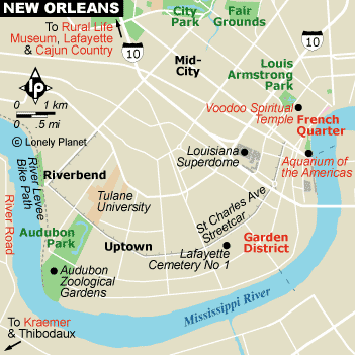
At the big toe of boot-shaped Louisiana, New Orleans nestles between Lake Pontchartrain, a huge but shallow body of saltwater that
forms the northern edge of town, and a meniscus-shaped bend of the Mississippi
River, about 145 river kilometres (90mi) above where
it empties into the Gulf of Mexico. The original and most visited portions of
the city parallel the northern riverbank. Directions upriver or downriver are
relative to the water flow, which bends maddeningly to all points of the
compass. The Mississippi and Lake
Pontchartrain also provide 'riverside'
or 'lakeside' orientation.
New Orleans comprises a
checkerboard of neighborhoods of different wealth and ethnicity - it's often
only a few steps from ghetto to endowed estates. At the easternmost point of
the city's crescent-shaped core is the heart of the original city, the French
Quarter. To the southwest, the Uptown area encompasses the Garden District,
universities and palatial mansions along the St Charles Ave Streetcar Line,
which leads to the Riverbend area at the other end of
the crescent.
Older faubourgs (suburbs) border the
crowded French Quarter - to the east, the Faubourg Marigny appeals to a bohemian, mostly gay crowd, while the
more down-at-heels Faubourg Tremé
to the north is a black neighborhood known for its music. Downriver from Faubourg Marigny is the Bywater, a burgeoning artist hangout in an otherwise
marginal district.
New Orleans International Airport (MSY) is 18km (11mi) west of the city
center in Kenner, while both trains
and buses share New Orleans Union Passenger Terminal ('Union Station') on Loyola
Ave in the Central Business District (CBD),
between the French Quarter and the Uptown area.
West of New Orleans you'll find the Cajun wetlands, an area of French
patois-speaking rural people who still depend on the natural resources of the
swamps. The Cajuns' Spanish counterparts, the Isleños,
live in the coastal fishing villages south of New Orleans.
Upstream along the Mississippi River, antebellum sugar
plantations attract visitors who marvel at elegant plantation homes. An
occasional slave cabin remains as a reminder of how the wealth was gained.
When to Go
New Orleans' climate is
influenced by its subtropical latitude and proximity to the Gulf of
Mexico. It's hot, wet and sticky for most of the year - other
times it's just wet. February through April is the best time to visit, when an
easygoing climate coincides with the city's two most spectacular events, Mardi Gras and Jazz Fest. May sees the heat begin to intensify,
and June marks the official beginning of hurricane season, which lasts through
September. The oppressive heat and humidity of the summer months are a misery,
driving many residents to the 'redneck Riviera'
of gulf coast Mississippi.
If you're visiting in summer, prepare for the 'oven' effect of going from
chilly air-conditioned interiors to overwhelmingly tropical 95°F (35°C)
streets. September and October tend to be much more agreeable. Christmas is an
off-peak period with discounted accommodations, although the winter
temperatures during the large New Year's Eve celebration and the Sugar Bowl
football game can be chilly.
HOME
Events
Of all American cities, New Orleans
knows best how to party. Its hip-swinging insouciance, greasy-chinned hedonism
and cosmopolitan embrace of different cultures and artforms
combine to lift it above (or deliciously below) the Calvinist mindset that
still haunts the rest of the US.
Let 'em roll!
Booze, beads and bare-breasted revelers, right?
Well, if you think that's all there is to Mardi Gras,
then honey you're in for a treat. French for 'Fat Tuesday,' Mardi Gras is a Roman Catholic celebration ushering in the 40-day
Lenten season before Easter. It takes place the day before Ash Wednesday, which
can be any Tuesday from 3 February to 9 March, depending on the date of Easter.
Seeing as Lent demands fasting from meat, Mardi Gras
has always represented a last chance to indulge.
New Orleans' ribald version of
the events include several weeks' worth of fun and fabulousness leading up to
Mardi Gras. Though the big masquerade balls are often
private affairs, there's no shortage of public parades and gatherings. The
bacchanalian nightlife really starts to heat up about two weeks before Mardi Gras, with nonstop nonsense from the Thursday before. Don't
even think of showing up without a costume of some sort - even a simple mask
will transform you into a worthy party peer.
In homage to New Orleans' jazz traditions, on the 250th anniversary of the
city's founding (1968), an all-star lineup of jazz-scene giants came together
for the first ever New Orleans Jazz & Heritage Festival. A few years later,
'Jazz Fest' expanded to include two weekends in late April and early May and a
variety of musical forms besides jazz. Today, Jazz Fest features music to suit
just about anybody's tastes, with thousands of performers on more than 10
stages displaying styles ranging from big band to zydeco.
The 'Heritage' portion of the title refers to the army of Louisianan arts,
crafts and food purveyors gathered downtown at Armstrong
Park. Do yourself a favor and
arrive hungry - the food on offer is a festival unto itself. If you're new to
the region, this is an excellent place to get your culinary bearings.
Other somewhat less boisterous celebrations include the Black Heritage
Festival on the second weekend in March, the Tennessee Williams Literary
Festival on the last weekend in March, the French Quarter Festival on the
second weekend in April, the Greek Festival on Memorial Day weekend in May and
the raucous riverfront Carnaval Latino on the last
weekend in June. Independence Day (Fourth of July) features food and
entertainment along the riverfront and star-studded musical performances at the
Superdome, followed of course by a barrage of fireworks.
Public Holidays
1 Jan - New Year's Day
third Monday in January - Martin Luther King Jnr Day
third Monday in February - President's Day
Feb/Mar - Mardi Gras Day
Mar/Apr - Easter Sunday
last Monday in May - Memorial Day
4 Jul - Independence Day
first Monday in September - Labor day
second Monday in October - Columbus Day
11 Nov - Veteran's Day
25 Dec - Christmas day
Attractions
Aquarium of the Americas
New Orleans voters should be
congratulated for funding the Aquarium of the Americas,
operated by the Audubon Institute. Here you can go eye-to-eye with giant
tropical creatures from the Amazon basin, see spotted moray eels and hawksbill
turtles in a walk-through Caribbean reef tube or watch incredible specimens of
Gulf species through 14ft (4m) high windows. Mr Bill,
a 40 year old sawfish, even shares his tank with an oil platform (that doesn't
leak). Of course, the Mississippi River and Delta
wetlands environments are displayed, but the 'Americas'
apparently extend to the farthest reaches of the Arctic.
The air-conditioned aquarium is at the foot of Canal
St, near Woldenberg Park
and next to the Canal St Ferry. Use the Riverfront streetcar if you don't want
to walk from the French Quarter. The Zoo Cruise also docks here, and you can
get a variety of combination tickets to both the Audubon Zoo and the aquarium,
including the price of the cruise.
French Quarter
The French Quarter (or Vieux Carré,
as it's sometimes called) was the city's original focal point and remains its
chief tourist draw. It houses nearly all New Orleans'
signature tourist icons, and Bourbon Street
alone, with its stormy nightlife and seedy sex shows, defines the city's bawdy
character.
What surprises most newcomers is that despite the
name, the Quarter is noted for its Spanish, not French, architecture. With the
exception of the Old Ursuline Convent - the oldest
building in New Orleans, dating
from 1745 - the district's French-designed buildings were destroyed by the
tremendous fires of 1788 and 1794. The distinctly Spanish character that
emerged in the rebuilt city is seen today in its broad window openings, crowned
by graceful arches, and handsome fan-shaped transoms. Lacy ironwork railings on
galleries overhanging the street are particularly emblematic.
Royal Street, the main drag of the French Quarter, is the postcard image of
the neighborhood: its cast-iron galleries and Greek Revival
buildings make camera shutters click like locusts in heat. Jackson
Square remains the central and most important
starting point for visitors to the Quarter, with its nebulous assortment of
street musicians, artists, fortune tellers and mimes doing their shtick on the
sidewalk. On adjacent Chartres
St, two notable history museums are the Cabildo and the Presbytère, the
former emphasizing the external impact of New Orleans,
the latter concentrating on its internal history.
Garden District
Like the French Quarter, this is a National Historic District, where
architectural preservation ordinances prevent would-be developers from fiddling
with its period character. The free guided National Park Service 'Faubourg Promenade' provides an overview of the Garden
District, but it's more fun to explore it on your own - especially since it's
an ideal zone for bicycling.
Aside from the eerie splendor of Spanish moss and the tranquil allure of the
Georgian manors, the key attractions of the district are the Audubon Zoological
Gardens, one of the country's richest collections of exotic wildlife; Tulane
University, with repositories specializing in African-American history and New
Orleans' jazz legacy; and Lafayette Cemetery No 1, where above-ground tombs let
you ponder up close what makes Anne Rice's vampire novels seem so perfectly
suited to their setting. The Garden District is 1.5mi (2.5km) southwest of the
French Quarter; the St Charles Ave Streetcar Line cuts right through its
northern half.
Historic Voodoo Museum
If you're strolling in the French Quarter, look for the Historic Voodoo
Museum on Dumaine St. Half market, half museum, it's
a one-stop shop for all you need to get your mojo risin' and keep it there. Whether it's gris-gris you're needing for grandma's arthritis or a penis doll to
stop your man from running around on you, this is your place. The museum is
only worth visiting when it's uncrowded and a guide
is available to talk about the potions, rituals and people, since the exhibits
are not self-explanatory.
Voodoo Spiritual
Temple
One meaning assigned to voodoo, 'being in a trance,' is in part derived from
the lack of proper burial for slaves, which was believed to result in restless
souls or the walking dead, also called zombies or plat-eyes. In New
Orleans, the spirits of deceased ancestors are
carefully protected through common rituals such as jazz funerals, featuring
brassy bands and a 'second line' of paraders in top
hats and umbrellas.
At the Voodoo Spiritual
Temple on N
Rampart St in the French Quarter, Priestess Miriam
Chamani primarily practices spiritual healing rituals
based on Afrocentric American Voodooism.
Her temple promotes neither white nor black magic, but instead focuses on
'true spiritual power for friendly people.' She continues a tradition established
by her New Orleans ancestors,
Dr John (the voodoo practitioner from the 1820s, not the contemporary musician),
Marie Laveau and Leafy Anderson. Drop by the small storefront temple
to chat, pick up books on the occult or check out the small collection of
art and artefacts from around the world.
HOME
Off the Beaten Track
Cajun Country
This region fans out from its centre in Lafayette
to the Texas border in the west
and the Mississippi River south of New
Orleans in the east. Its bayous and swamps are havens
for birds, alligators and other wildlife, as well as being the home of Cajun
music, zydeco and swamp pop. Visitors can pick up the
two-step at dance halls, block parties and festivals throughout the year, but
the best time to come is during the spring crawfish season, to join in the
tasty head-sucking and tail-squeezing rituals. New Orleans,
while not part of Cajun Country, is home to scores of
Cajuns who have migrated to the city to make a living from their world-famous
cuisine, music and spirited bon temps.
Lafayette is a good destination
itself and makes an easy base of operations for exploring the rest of the
region. While some rural attractions might be hit-or-miss depending on the time
of your visit (try to schedule your visit to coincide with a local festival), Lafayette
offers a guaranteed good time throughout the year. The most picturesque of the
outlying areas are along Bayou Teche (east and south
of Lafayette), while the earthiest
choices are Gibson in the wetlands and Mamou in the
prairie. Lafayette is 130mi (210km)
west of New Orleans via I-10 (around
2.5 hours) or 165mi (265km) and up to a full day's leisurely drive along Hwy
90. Buses and trains run between the cities frequently, and there are nice
routes for bicycles if you're prepared for the frequent south Louisiana
rain.
Kraemer
You haven't seen Cajun Country until you've been out in the swamp, and you
won't find a more authentic swamp tour than those given by the Cajuns of
Kraemer. The road into town barely skims the swamp's surface, and once you're
there, motorized boat rides bring you closer still. Tours through the
surrounding bayous are led by guides who tend to overplay the hick routine but
nevertheless are the real thing. Among the tours' attractions, visitors are
treated to a stop by Zam's pond of 'wrestling
gators.' The rancid smell? Oh, that's just the
thousands of alligator heads and hides drying in the shed nearby. And if all
the bayou bogginess hasn't stolen your appetite, over at Edwina's Cooking Cajun
hardy eaters can test their mettle with a plateful of the house special, gator piquante over rice.
Tours, including the obligatory alligator feeding spectacle, are scheduled
daily. Kraemer is about 50mi (80km) southwest of New Orleans
via Hwy 90 and Route 307. Buses wouldn't dare.
Lafayette
French refugees from Nova Scotia
(at the time known as Acadia) began arriving in New
Orleans in 1755 after British seizure of French
Canada. Mostly illiterate Catholic peasants, they soon found they were also
unwelcome in New Orleans. Creole
society banished them to the countryside west of the city, where most settled
the upland prairie of Bayou Teche. Descendants of the
Acadians, or Cajuns as they are now called, continue to occupy the area today,
forming one of the nation's largest and most distinct
cultural enclaves in one of its most exotic locales.
River Road
Elaborate plantation homes line the banks of the Mississippi
River between New Orleans
and Baton Rouge along what's known
as the River Road, a series
of sinuous levees on the east and west banks of the Mississippi,
between 60 and 90 minutes' drive from New Orleans.
Tours of these hallmarks of antebellum ostentation tend to cater to common
preconceptions about the elegance and 'Southern charm' of American planters.
Past owners' deeds are sometimes outrageously embellished and supernatural
happenings are frequently invoked to jazz up an otherwise mundane tour. Sadly,
the history of their sizable slave populations is often ignored. Nevertheless,
the scenic grounds and handsome mansions offers a
potent reminder of the legacy of King Cotton. Full or part-day tours can be
arranged from most hostels and hotels in New Orleans.
Interstate 10 offers the quickest access to the east bank levee roads.
Parallel to I-10, slower Hwy 61 passes through suburbs and intersects rural
crossroads. Ferries still outnumber bridges across the river.
Rural Life Museum
The focus of this museum, contrary to the opulent images presented at many
plantation homes, is on everyday life in the 19th century. Operated by
Louisiana State University on the former Windrush
Plantation near Baton Rouge, its grounds showcase a matchless collection of
rural buildings typically found on sugar plantations, including slave cottages,
a commissary and shotgun house, an overseer's house, a cane grinder and a sugar
house with a 'Jamaica train' of open kettles.
It's not all about plantation life: there's also an Acadian house, a pioneer
cabin and a functioning blacksmith shop open to visitors. In the barn museum,
exhibits depict technology and folklife; especially
interesting are the African artefacts and slave
implements. Special demonstrations like weaving or blacksmithing are conducted
on the first Saturday of the month. Baton Rouge
is a two hour drive west of New Orleans
on I-10; buses and trains make the run several times daily.
Wetlands Cajun Cultural Center
The Wetlands Cajun
Cultural Center
in Thibodaux is a spacious National
Park Service-operated museum and gallery. Professional exhibits cover virtually
every aspect of Cajun life in the wetlands, from their music and the environmental
impacts of trapping to the 'the time of shame' (1916 to 1968), when the
Louisiana Board of Education discouraged use of the French language. Cajun
musicians jam on Monday evenings.
Thibodaux is 60mi (97km)
southwest of New Orleans via Hwy 90
and Hwy 1; Greyhound buses run twice daily.
Activities
Revelling is the customary New
Orleans way to keep fit; somehow activities like
jogging and squash just don't fit the image of the city. It
somewhat of a drawcard for anglers, however, due to
the solid bayou tradition of hunting and fishing. The flatness of the
landscape also make it ideal for wheel sporters of all kinds including bladers
and cyclists.
History
Nomadic Paleo-Indians probably spent time in the New
Orleans area over 10,000 years ago. By the time the
French founded the city in 1718, seven small tribes known as the Muskogeans inhabited the Florida Parishes north of Lake
Pontchartrain and occasionally the banks
of the Mississippi River. Other tribes south of New
Orleans inhabited the bayous in Barataria
and the lower course of the Mississippi River.
In 1699, brothers Pierre Le Moyne and Jean-Baptist
Le Moyne de Bienville became the first Europeans to
ply the Mississippi upriver from
the Gulf of Mexico. Guided by a Native American, they
sailed north, pausing to note the narrow portage to Lake Pontchartrain. Less than twenty years later,
Bienville returned to lay out Nouvelle Orleans on that same spot.
Early settlers arrived mostly from France,
Canada and Germany,
while the French imported thousands of African slaves. Despite the influx,
however, colonial mercantilism proved an economic failure in New
Orleans and the harsh realities of life there kept
further civilian immigration at a minimum. The colonists developed an exchange
economy based on smuggling and local trade, while their city earned a
reputation for its illegal enterprise and swarthy character.
In 1762, the French ceded the Louisiana
territory to the Spanish in exchange for help in France's
war against England.
During this time, French refugees from Nova Scotia
(Acadia) began arriving, following the British
seizure of French Canada. (The British deported thousands of Acadians for
refusing to pledge allegiance to England.)
Unfortunately for the Acadians - or Cajuns, as they are now called - no one had
told them they were to become Spanish subjects. Creole society turned their
noses up at them and banished the Acadians to the bayous west of the city,
where they continued their livelihood of raising livestock.
France
regained possession in 1800 and took up an offer to buy it from Thomas
Jefferson, who coveted the river capital to proceed on a path of western
expansionism. Preferring it fall into American rather than British hands,
Napoleon sold the entire Louisiana Territory
at a price of US$15 million. On 20
December 1803, the French tricolor on the Place d'Armes
was quietly replaced by the American flag.
In town, the response to American control was less than welcoming.
Protestant American culture was seen as domineering and vulgar. In 1808, the
territorial legislature adopted elements of Spanish and French laws -
especially the Napoleonic Code - elements of which persist in Louisiana
to the present.
By 1840 it was the nation's fourth city to exceed 100,000 inhabitants.
Americans gained control of the municipal government in 1852 and by 1850, New Orleans
had become the South's largest slave-trading center. Though Louisiana
was the sixth state to secede in 1860, New Orleans
actually voted three-to-one to preserve the Union and
became the first Confederate city to be captured.
After the fall of New Orleans,
about 24,000 Louisiana blacks
served in the Union forces and played a key role in the Reconstruction. After
occupying troops left in 1877, many civil rights gains were lost as Jim Crow
segregation became commonplace, with skin color serving as the ultimate arbiter
for people who chose not to trace their lineage. Governor Huey Long reportedly
summed up the distinction by noting that all the 'pure whites' in Louisiana
could be fed 'with a nickel's worth of red beans and a dime's worth of rice.'
By the early 20th century, New Orleans
was ripe for the musical revolution that gave birth to jazz. Blacks had long
congregated at Congo Square
every Sunday to dance and sing to an African drumbeat - the only place in the
South where this was permitted. Eventually, the indigenous musical genre called
jazz took shape, with many early jazz musicians performing in the red-light
district.
As the 20th century dawned, New Orleans
struggled to get itself back on track after the turmoil of Reconstruction. It
snapped out of the Great Depression as WWII industries created jobs, and
continued prosperity in the 1950s led to suburban growth around the city.
Desegregation laws finally brought an end to Jim Crow, but traditions shaped by
racism were not so easily reversed. As poor blacks moved into the city, many
middle-class whites moved out. New Orleans'
population quickly became predominantly black. The city's tax base declined,
and many neighborhoods fell into neglect. However, the French Quarter, which
had become a dowdy working-class enclave after the Civil War, was treated to
restoration efforts, and it emerged primed for mass tourism, which was becoming
one of the city's most lucrative industries. Even as the oil and chemical
industries boomed in Louisiana,
spurred on by low taxes and lenient environmental restrictions, New
Orleans fastened its eyes on the tourist dollar. In
the mid-1970s the Louisiana Superdome opened. The home of the city's NFL team,
the Saints, it has also hosted Superbowls and
presidential conventions and sparked a major revenue-earner for New
Orleans: trade shows. All around the Superdome, new
skyscrapers rose in the Central Business District, but by the end of the 1980s,
the local oil boom went bust.
Today, the steady growth of tourism - despite reports of the city's high
crime rate - makes up an increasing share of the employment opportunities in New
Orleans. Like most US cities at the end of the
millennium, New Orleans benefited
from trends toward urban revival, and crime has dropped in recent years. Still,
New Orleans remains largely a poor
city with a small tax base to support public schools and social programmes. Gentrification has mostly highlighted a growing
divide between the haves and have-nots. And, still, the divide is defined
primarily by race. Nothing, however, can subdue the resilient spirit of this
most seductive of cities.
Getting There & Away
New Orleans International
Airport's flights are about 98%
domestic - the only 'international' flights are with other North and Central
American countries. Its proximity to major hubs at Dallas-Fort Worth, Houston
and Atlanta make it easy to find a
convenient flight or connection to and from just about anywhere in North
America.
As is typical throughout the South, you can rely on good bus service to New
Orleans. Greyhound is the only regular long-distance
bus company operating to the city. All trains and Greyhound buses share the New
Orleans Union Passenger Terminal, seven blocks upriver from Canal
St.
Interstate 10 is the nation's major east-west route along the southern
boundary linking Jacksonville with Los
Angeles via New Orleans.
The north-south routes, I-55 to Chicago
and I-59 to Chattanooga, meet I-10
to the west and east of New Orleans
on either side of Lake Pontchartrain.
As it is across the US,
driving is done on the right.
Visitors to New Orleans during
Mark Twain's time arrived by boat via the Mississippi River.
This once-common mode of travel continues to be offered by a few paddlewheel
river boats and ocean-going cruise ships. Costs are high compared to other
travel modes - the era of steerage passage is over - and river travel is now
typically offered as a package tour or excursion that includes top-end food and
lodging.
Getting Around
Three Amtrak trains serve New Orleans
at the Union Passenger Terminal. The City of New
Orleans runs to Memphis,
Jackson and Chicago;
the Crescent Route serves Birmingham,
Atlanta, Washington
and New York City; and the Sunset
Limited rolls between Los Angeles
and Miami.
The Regional Transit Authority (RTA) offers decent bus and streetcar
service. From the French Quarter, most destinations are served by buses that
stop at the intersection of Basin and Canal Sts. All stops have signs noting
the route name and number - you may have to explore all four corners of an
intersection to find the stop you want. The free New Orleans Street Map,
available from information booths at the airport and downtown, shows most route
numbers and lists the route names you can expect to see displayed on the front
of the bus.
Bringing a car to downtown New Orleans
is a costly proposition, and traffic and parking congestion may actually hinder
your visit. That said, all the big rental companies
can be found in the city or at the airport.
New Orleans has two streetcar
lines in operation. The 1923-24 vintage cars of the St Charles Ave Streetcar
Line still rumble through streetcar-era suburbs full of Georgian architecture
and ornate churches. The Riverfront Streetcar Line operates vintage red cars on
the old dockside rail corridor. Its two-mile run connects the Old US Mint, in
the lower end of the French Quarter near the Faubourg
Marigny, and the upriver Convention Center, passing Canal
St on the way. These two lines will eventually be
linked by a new Canal St
line.
Further Reading
- Historical Atlas of Louisiana by Charles Robert Goins and John Michael Caldwell: A great resource for
finding out about New Orleans history in a state-wide
context.
- Encyclopedia of Southern Culture by Charles Reagan Wilson (ed): The facts are at your fingertips with this
wrist-breaking tome, which offers comprehensive coverage of everything
from agriculture to women's life.
- Landmarks of New Orleans by Leonard V Huber: Revved-up
history buffs can use this book to devise their own architectural tours of
the city.
- Gumbo Ya Ya by WPA: In the late 1930s, a Federal Writer's Program commissioned
this collection of Louisiana folk tales as a way to employ
writers left jobless by the Depression.
- A Streetcar Named Desire by Tennessee Williams:
Williams won the Pulitzer Prize with his portayal
of a fading, fragile belle.
- Bandits by Elmore Leonard: Crime writer Leonard set this book
in his native New Orleans.
- Interview with the Vampire by Anne Rice: The first of
Rice's famous vampire trilogy makes spooky use of New Orleans' steamy weather and swampy
vegetation.
- Burning Angel by James Lee Burke: A mob story set aginst a New Orleans backdrop.
- A Confederacy of Dunces by John Kennedy O'Toole:
O'Toole was an unsung genius who died before his this novel centred on New Orleans and neurotic anti-hero
Ignatius Reilly could become legend.